
Japanese Wagyu should feel exciting, not like decoding a label. When you see Miyazaki, Hida, Omi or Tokushima beside a grade such as A5, start with three things: the regional or brand name, the carcass grade, and the cut or format. Once those are clear, choosing a pack for steak night, sharing or hotpot becomes much easier.
Quick answer
Miyazaki Beef, Hida Beef, Omi Beef and Awa Beef each follow their own qualifying standards. A product described as Wagyu from Tokushima is not automatically Awa Beef. None of these regional names alone confirms A5, one exact BMS number, the cut or the pack format.
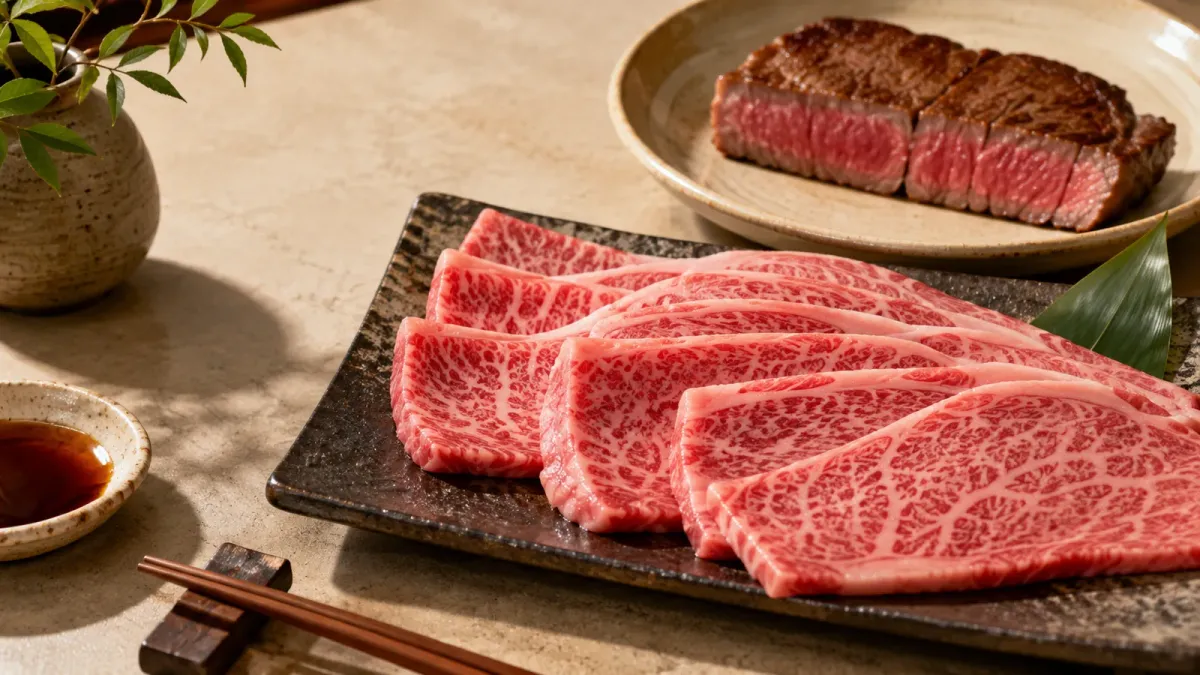
A quick note: My MeatBox may not carry all four regional brands at the same time. The featured image is a serving visual, not a comparison of four verified products. For a specific item, use the live product page and pack label to confirm the exact name, grade, cut, pack size, price, promotion terms and availability.
Start with region, grade and cut
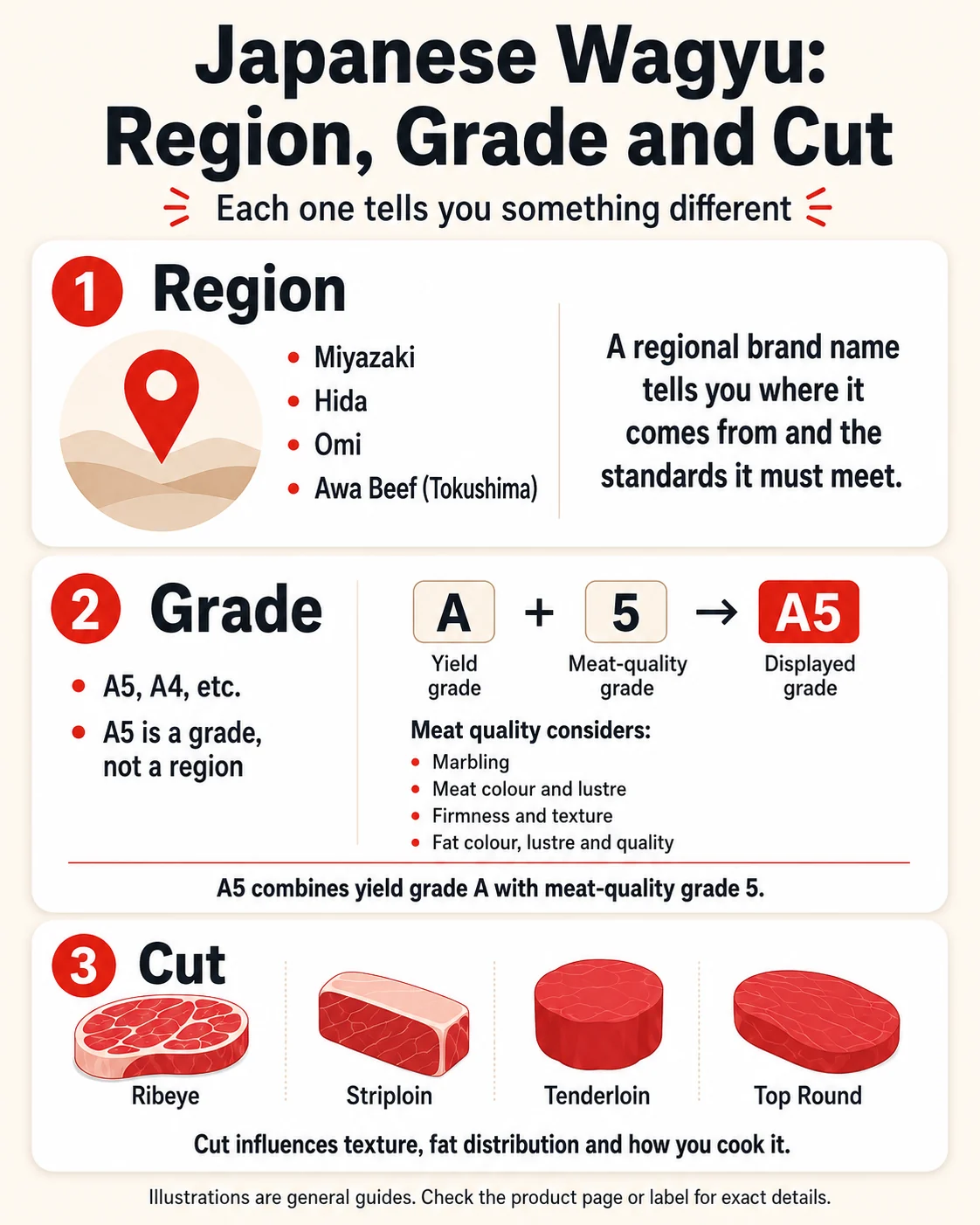
Region explains origin and qualifying standards. Grade explains how the carcass was assessed. Cut or format helps you plan the cooking method, portion and texture.
What A5 actually tells you
In A5, “A” is the yield grade and “5” is the meat-quality grade. Meat quality is assessed across four areas: marbling; meat colour and lustre; firmness and texture; and fat colour, lustre and quality. The final meat-quality grade follows the lowest of those four assessments. Meat-quality grade 5 covers Beef Marbling Standard (BMS) No. 8 to No. 12, so A5 does not automatically mean BMS 12.
Miyazaki, Hida, Omi and Awa Beef compared
Use the visual for a quick overview, then read the short summaries for the qualifying criteria and what to check before buying.
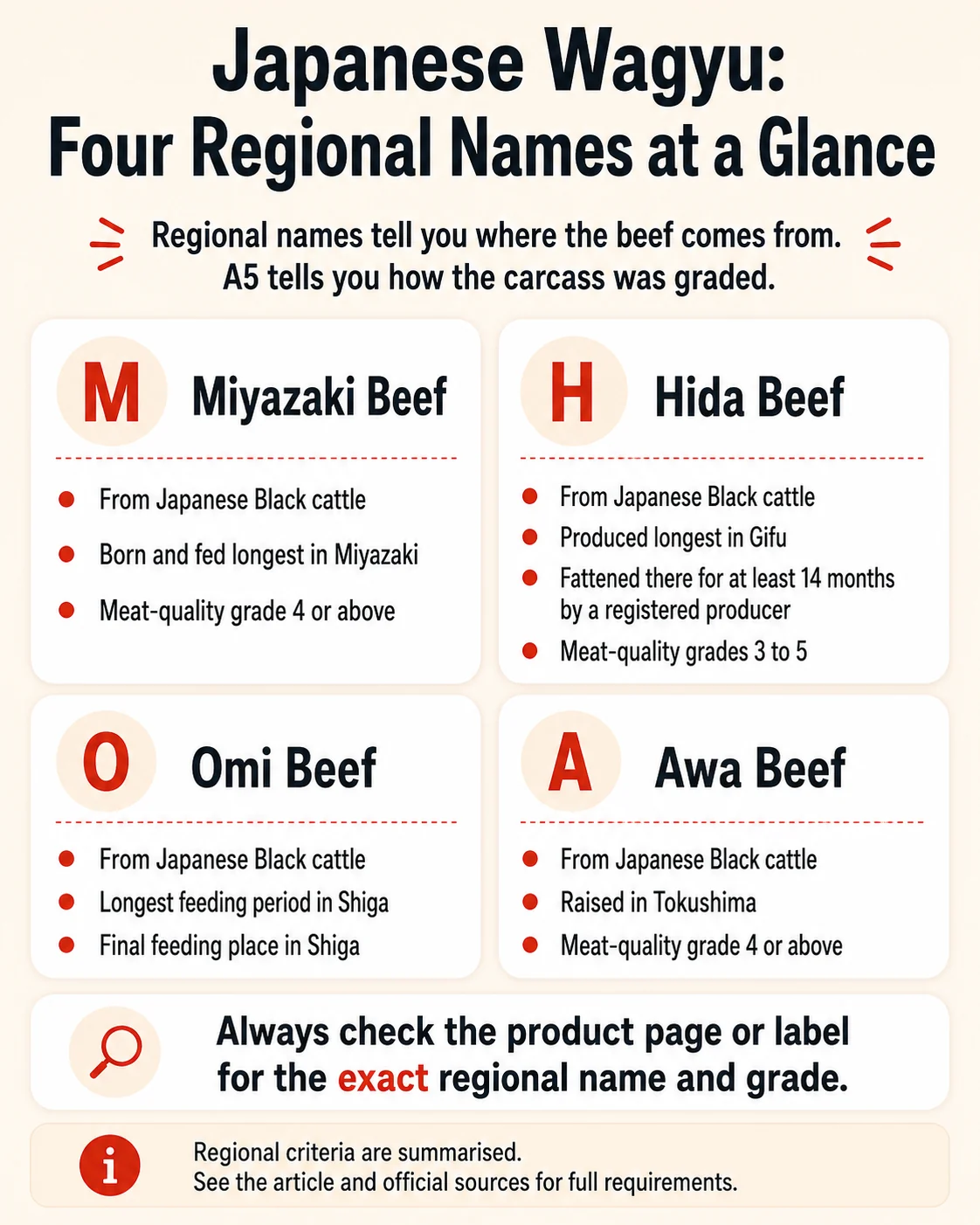
Miyazaki Beef
What it confirms: A registered regional brand name for qualifying Japanese Black beef from Miyazaki Prefecture.
Criteria in brief: From Japanese Black cattle born in Miyazaki, fed there for the longest part of their feeding period, and graded meat quality 4 or above.
Check before buying: Confirm the full grade, cut and pack size. Miyazaki Beef is not automatically A5.
Hida Beef
What it confirms: A defined Japanese Black beef brand from Gifu Prefecture with its own producer, feeding and grade requirements.
Criteria in brief: Produced longest in Gifu, fattened there for at least 14 months by a producer certified and registered under the Hida Beef system, and graded meat quality 3, 4 or 5.
Check before buying: Confirm the full grade stated for the product. Hida Beef is not automatically A5.
Omi Beef
What it confirms: A registered regional name for Japanese Black beef from Shiga Prefecture.
Criteria in brief: The cattle must spend the longest part of their feeding period in Shiga, and Shiga must also be the final feeding place.
Check before buying: Confirm the full grade, cut and pack details stated for the specific product.
Awa Beef
What it confirms: A defined Tokushima regional brand. It is not a general name for every Wagyu product raised in Tokushima.
Criteria in brief: Tokushima Prefecture describes Awa Beef as Japanese Black beef reared in Tokushima, with meat-quality grade 4 or above.
Check before buying: Only treat a product as Awa Beef when the product page, label or supplier information specifically says Awa Beef. The prefecture’s English page also refers to a “fine pedigree”, but does not define a measurable threshold.
Why there is no single “best” region
No regional name is automatically the best choice for every meal. Producer, carcass grade, cut, marbling distribution, thickness, storage and cooking all shape the final bite. The better choice is the pack that suits how you plan to cook and share it.
How to choose the right Japanese Wagyu
Start with the meal, then narrow down by region and grade. No need to choose by the biggest name alone.
Choose a pack with the cut, thickness and weight clearly shown. Highly marbled Japanese Wagyu can be rich, so a smaller portion often feels just right for sharing.
Yakiniku slices, dice or skewers, when available, are easy to cook in small batches and share around the table.
Choose shabu-style slices when available for a quick dip in hot broth. Thin slices cook fast, so do not follow steak timings.
Compare the same cut, a similar grade, a similar portion and the same cooking method. Otherwise, you may be comparing the format more than the region.
Label-reading checklist
Frequently asked questions
Tap a question to open the answer.
Planning a Japanese Wagyu meal at home?
Start with our Miyazaki Wagyu guide to understand the regional name and current My MeatBox listing. When you are ready, check the live product page for the available cuts, pack sizes and availability.
Explore Miyazaki WagyuSources and verification
- Japan GI information site: Miyazaki Beef
- Hida Beef Brand Promotion Council: Definition and labelling
- Japan GI information site: Omi Beef
- Tokushima Prefectural Government: Awa Beef
- Japan Meat Grading Association: Beef carcass grading standards
Last checked against regional, government and grading sources: . For a specific product, the live product page and pack label take priority.